

Cotton is defined as a natural cellulose fiber that biodegrades in soil, releases no persistent microplastics, and absorbs moisture at rates up to 17 times higher than polyester. These properties make it the stronger choice for anyone building a wardrobe with sustainability and comfort in mind. The debate around natural vs synthetic materials has sharpened considerably in 2026, with new lifecycle and microfiber research giving cotton advocates solid ground to stand on. Understanding why cotton is better than synthetics means looking at the science behind fiber breakdown, pollution, and how fabric actually behaves against your skin.
Why cotton is better than synthetics: the core evidence
The most compelling case for cotton over synthetic fibers comes down to what happens after you wash your clothes and after you throw them away. Both outcomes favor cotton by a significant margin.
When you wash a polyester garment, it sheds microfibers that persist in aquatic environments. A 2026 MDPI study reports microfiber discharge rates of 0.1 to 1 mg/g for PET fabrics. These plastic-based fibers do not biodegrade. They accumulate in waterways, enter the food chain, and remain environmentally active for decades. Cotton also sheds microfibers during washing, and by raw mass it can shed more. The critical difference is that cotton’s cellulose fibers break down in natural environments, while polyester microfibers do not.

At end-of-life, the gap widens further. A 2026 MDPI biodegradation study using respirometric and micro-CT imaging found that cotton reached approximately 115% mineralization after 90 days in soil. Polyester, tested under the same conditions, remained structurally stable with only surface-level alterations. That means a discarded cotton T-shirt returns to the earth. A discarded polyester shirt does not.
These two data points form the foundation of the benefits of cotton over synthetics. Everything else, from comfort to carbon footprint, adds nuance to a case that starts here.
How does cotton compare to synthetics in microfiber pollution?
Microfiber pollution is one of the most discussed environmental issues in fashion right now, and the fiber type you choose directly determines the type of pollution your laundry generates.
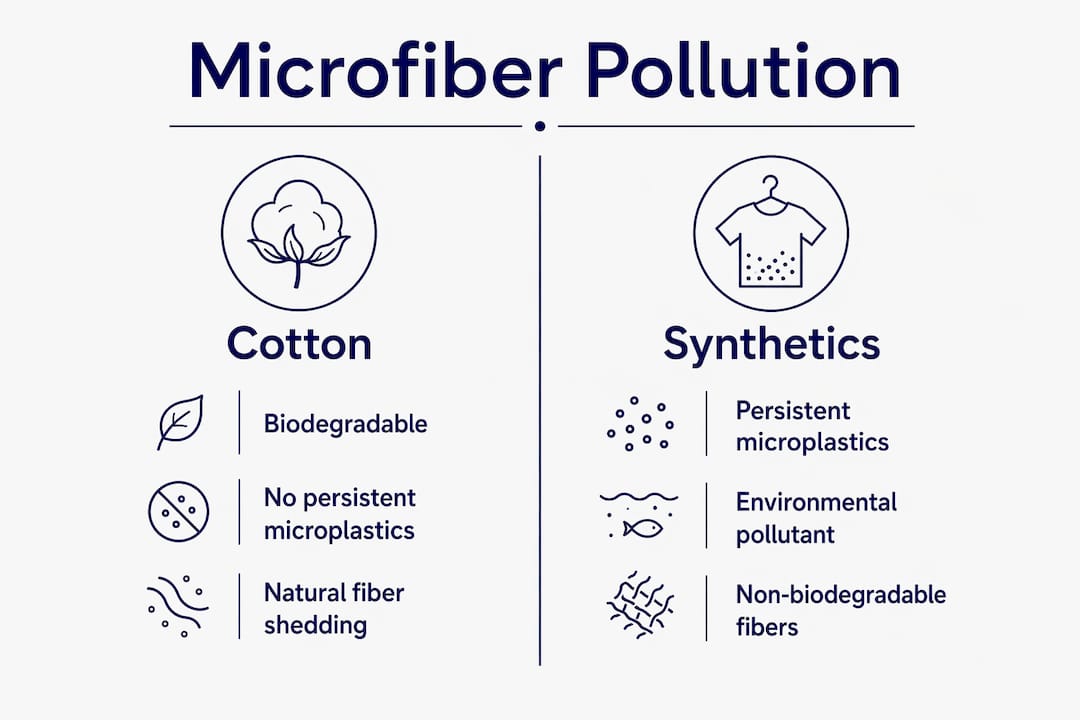
Polyester fleece and synthetic knits release PET microfibers that dominate ocean contamination samples globally. Unlike cotton fibers, PET microfibers carry no biological degradation pathway. They fragment into smaller particles over time but never fully break down. Microfiber release dynamics research confirms that shedding peaks in early wash cycles and then stabilizes, which means a new synthetic garment is its most polluting during the first several washes.
Cotton garments follow a similar shedding pattern, but the environmental consequence differs entirely. Here is how the two fiber types compare across key pollution metrics:
- Persistence in water: Polyester microfibers remain in aquatic environments indefinitely. Cotton microfibers biodegrade within weeks to months depending on conditions.
- Ocean contamination: Synthetic fibers, particularly PET from polyester, account for the majority of microplastic contamination found in ocean sediment samples.
- Finishing residues: Cotton garments can carry chemical finishing residues into wastewater during early washes, which is worth noting but does not change the fiber’s fundamental biodegradability.
- Shedding volume: Cotton may shed more microfibers by mass in a single wash, but the environmental persistence of those fibers is incomparably lower than that of synthetic alternatives.
Fabric construction also matters. Loosely woven or brushed cotton fabrics shed more than tightly woven ones. Choosing a well-constructed cotton garment, such as a dense pique cotton polo or a tightly woven canvas cap, reduces shedding without sacrificing the fiber’s environmental advantages.
What are the biodegradation differences between cotton and synthetic fabrics?
Biodegradation is where the advantages of cotton fabric become scientifically undeniable. The 2026 MDPI study referenced above used two methods to measure textile breakdown: respirometry, which tracks carbon dioxide release as a measure of microbial activity, and micro-CT imaging, which creates three-dimensional scans of fiber structure over time.
Cotton’s cellulose structure is recognized and consumed by soil microorganisms. The 115% mineralization figure sounds counterintuitive, but it reflects the fact that cotton fibers stimulate microbial activity beyond their own mass, contributing positively to soil biology. Polyester, by contrast, showed no meaningful breakdown. Its synthetic polymer chains are not recognized by natural biological systems.
Blended fabrics, such as a 60/40 cotton-polyester mix, present a more complicated picture. The cotton fraction degrades, but the polyester fraction remains. This means a blended garment leaves behind a ghost of synthetic fiber even after the cotton component has fully broken down. For consumers prioritizing end-of-life sustainability, 100% cotton is the cleaner choice.
Pro Tip: Check garment labels before purchasing. A fabric listed as “cotton-rich” may still contain 30 to 40% polyester, which will persist in landfill long after the cotton fraction has biodegraded.
| Fiber type | Biodegradation outcome after 90 days in soil |
|---|---|
| 100% cotton | Approximately 115% mineralization; full structural breakdown |
| 100% polyester | Structurally stable; surface alterations only |
| Cotton-polyester blend | Cotton fraction degrades; polyester fraction persists |
How does moisture management and comfort differ between cotton and synthetics?
Cotton’s moisture regain of approximately 8.5% compared to polyester’s 0.4 to 0.5% tells you a great deal about how each fiber behaves against your skin. Cotton absorbs sweat into its fiber structure, which creates an immediate cooling sensation as moisture evaporates. This is why a cotton T-shirt feels comfortable in warm weather and why cotton has been the default choice for everyday wear for centuries.
Polyester does not absorb moisture. Instead, engineered synthetic knits are designed to wick moisture away from the skin surface and spread it across the fabric for faster evaporation. This is genuinely useful for high-intensity exercise, where speed of drying matters more than the cooling sensation of absorption. However, polyester’s inability to absorb means sweat and odor compounds accumulate on the fiber surface, which is why synthetic athletic wear tends to retain odor more than cotton.
Fabric structure adds another layer to this comparison. A 2026 Scientific Reports study found that twill weaves promote higher one-way moisture transfer indices than plain weaves, regardless of fiber type. This means a well-constructed cotton twill can perform closer to a synthetic moisture-wicking fabric than a loosely woven cotton plain weave. Fiber choice matters, but construction is the multiplier.
Here is a practical breakdown of when each fiber type serves you better:
- Everyday wear, casual settings: Cotton wins. It breathes, absorbs, and feels natural against skin throughout a full day.
- High-intensity sport or outdoor activity: Engineered synthetics have a functional edge for moisture transport speed.
- Warm weather and travel: Cotton’s absorbent nature provides genuine cooling comfort, though it can feel heavier when fully saturated.
- Sensitive skin: Cotton’s natural fiber structure is less likely to cause irritation than synthetic polymers, making it the preferred choice for people with skin sensitivities.
Pro Tip: For warm-weather days when you want cotton’s comfort without the weight, look for lightweight pique cotton or single-jersey knits. These constructions maximize airflow while keeping the natural feel cotton is known for.
What are the broader environmental trade-offs of choosing cotton over synthetics?
The honest answer to “is cotton better than synthetic” from a full lifecycle perspective is: mostly yes, but with important caveats. A 2026 lifecycle assessment found that organic cotton trousers can carry a carbon footprint of approximately 12.23 kg CO2e, with 43 to 45% of that impact coming from the raw material acquisition stage. Certain polyester-cotton blends with recycled content scored lower on carbon in the same assessment. That number deserves context. It means cotton farming, irrigation, and processing carry real environmental costs that do not disappear simply because the fiber is natural.
The same LCA research emphasizes that sustainability outcomes depend heavily on supply chain decisions, regional energy sources, and how long a garment is actually worn. A cotton T-shirt worn 200 times has a dramatically lower per-wear footprint than one worn 20 times. Durability and consumer behavior are as important as fiber choice.
Where cotton consistently outperforms synthetics is at end-of-life. No lifecycle model changes the fact that polyester persists in landfill and waterways indefinitely. For consumers who care about what their clothing does to the planet after disposal, cotton’s biodegradability is a non-negotiable advantage. Soloslife’s approach to sustainable sourcing reflects this thinking: choosing cotton is the starting point, but responsible manufacturing and garment longevity complete the picture.
How to choose cotton clothing for sustainability and comfort
Choosing cotton well means going beyond the fiber label. Here is what to look for when selecting garments that deliver on both sustainability and comfort:
- Prioritize organic or sustainably grown cotton. Organic cotton is grown without synthetic pesticides and uses less water than conventional cotton farming. Certifications like GOTS (Global Organic Textile Standard) or OCS (Organic Content Standard) give you verified proof of origin.
- Read the full fiber composition. A garment labeled “cotton blend” may contain significant polyester. For maximum biodegradability and comfort, aim for 100% cotton or at least 80% cotton content.
- Match fabric construction to your activity. Dense weaves and knits like pique cotton or canvas work well for everyday wear and accessories. Lighter jersey knits suit warmer climates and casual layering.
- Wash less and wash cold. Microfiber shedding peaks in early wash cycles. Washing garments less frequently and at lower temperatures extends garment life and reduces both fiber shedding and energy use.
- Invest in quality over quantity. A well-made cotton garment that lasts five years beats three cheap ones that wear out in eighteen months. Garment longevity is one of the most impactful sustainability levers available to consumers, as lifecycle research consistently confirms.
- Consider the full supply chain. Brands that use non-toxic dyes, fair labor practices, and transparent sourcing amplify the environmental benefits of cotton fiber itself.
Key takeaways
Cotton’s biodegradability, natural moisture absorption, and absence of persistent microplastic pollution make it the stronger choice over synthetics for everyday sustainable fashion.
| Point | Details |
|---|---|
| Biodegradation advantage | Cotton reaches full soil breakdown in 90 days; polyester remains stable indefinitely. |
| Microfiber pollution | Cotton microfibers biodegrade; polyester microfibers persist in oceans and waterways. |
| Moisture and comfort | Cotton absorbs 8.5% moisture vs polyester’s 0.4%, delivering natural cooling for everyday wear. |
| Lifecycle nuance | Organic cotton can have a higher carbon footprint per garment, so garment longevity matters. |
| Buying smarter | Choose 100% organic cotton, wash less, and prioritize durable construction to maximize benefits. |
The part most sustainable fashion articles skip
We have spent years thinking about what it actually means to make a better clothing choice, and the honest conclusion is this: fiber type is the starting point, not the finish line. Most conversations about natural vs synthetic materials focus on production, which matters, but they underweight what happens at the end of a garment’s life. That is where cotton’s advantage is clearest and most permanent.
The carbon footprint data on organic cotton is real and worth taking seriously. Growing cotton requires land, water, and energy. We do not think that fact cancels out cotton’s benefits. We think it means the responsibility shifts to how you use and care for what you buy. A cotton garment worn regularly, washed thoughtfully, and kept for years has a smaller real-world footprint than almost any synthetic alternative.
What we have also learned is that consumers are more capable of holding this complexity than most brands give them credit for. You do not need to choose between comfort and conscience. You need accurate information and well-made products that reward long-term use. That is the standard we hold ourselves to at Soloslife, and it is the standard worth applying to every purchase you make.
— Solos
Dress better and tread lighter with Soloslife

Soloslife builds premium cotton essentials for people who want their wardrobe to reflect their values without sacrificing style. Every piece in the collection uses sustainably sourced cotton, non-toxic dyes, and responsible manufacturing practices. The premium cotton T-shirts and polos are cut for all-day comfort and built to last, which means fewer replacements and a lower long-term footprint. If you want to complete the look, the organic cotton canvas caps bring the same sustainable standards to your accessories. Explore the full range and make the switch to cotton that is worth wearing.
FAQ
Is cotton always better than synthetic fabrics?
Cotton is better than synthetics for everyday wear, biodegradability, and skin comfort, but engineered synthetics outperform cotton in high-intensity athletic use where rapid moisture transport is the priority.
Does cotton release microplastics when washed?
Cotton does not release microplastics. It sheds cellulose-based microfibers that biodegrade in natural environments, unlike polyester microfibers, which persist in waterways indefinitely.
Why choose cotton clothing over polyester for sustainability?
Cotton biodegrades fully in soil within 90 days, while polyester remains structurally stable. For consumers focused on end-of-life environmental impact, cotton is the clear choice.
Does organic cotton have a lower carbon footprint than polyester?
Not always. A 2026 lifecycle assessment found organic cotton trousers can carry a carbon footprint of approximately 12.23 kg CO2e, which can exceed certain polyester blends. Wearing garments longer reduces the per-wear impact significantly.
How can I reduce microfiber shedding from cotton garments?
Wash cotton garments less frequently, use cold water cycles, and choose tightly woven constructions like pique or canvas. Shedding peaks in early wash cycles and stabilizes with continued use.


