

TL;DR:
- Proving ethics in fashion requires verifiable evidence such as certifications, supply chain transparency, and forensic testing. Commercial audits are unreliable due to conflicts of interest and limited scope, while regulatory rules in 2026 demand specific proof for environmental claims. Consumers should verify claims through public registries, supplier lists, and scientific evidence to identify genuinely ethical brands.
Proving ethics in fashion means producing verifiable evidence of fair labour, responsible sourcing, and environmental accountability, not simply making claims in a marketing campaign. Certifications from bodies like GOTS (Global Organic Textile Standard) and Fair Trade USA provide a starting point, but credible proof now demands traceability, regulatory compliance, and independent verification. As a shopper who cares about where your clothes come from, understanding how fashion brands prove ethics helps you separate genuine commitment from polished spin. The standards are tightening in 2026, and the gap between real proof and clever marketing has never been more visible.
How fashion brands prove ethics: beyond the label
Ethical fashion practices are defined by the industry term “supply chain due diligence,” which covers every step from raw fibre to finished garment. A brand that genuinely proves its ethics does not stop at slapping a certification logo on a hangtag. It maintains documented evidence of who made the product, under what conditions, and with what materials.
The strongest proof points include third-party certifications, published supplier lists, factory audit reports, and traceability records that link a specific garment back to its origin. Brands like Patagonia and Eileen Fisher have published supplier lists for years, setting a benchmark that most of the industry still has not matched. For shoppers, the absence of this kind of disclosure is itself a signal worth noting.
Responsible fashion practices also require brands to address the full supply chain, including spinning mills, dye houses, and trim suppliers, not just the final assembly factory. Most ethical failures happen in these less visible tiers, which is exactly where credible brands focus their verification efforts.
Why audits alone don’t guarantee ethical production
Commercial social audits are the most common tool brands use to substantiate ethical claims, and they are frequently unreliable. A SOMO, Consumentenbond, and Clean Clothes Campaign report found that brands routinely use audit results to make overly general, inaccurate claims about no forced labour or safe workplaces. The audits themselves are often commissioned and paid for by the brand being assessed, which creates an obvious conflict of interest.
“Audited does not mean ethical. The audit system was designed to manage risk for brands, not to protect workers.” — SOMO/Clean Clothes Campaign
The concept of “social washing” describes exactly this problem. A brand presents audit-backed claims as proof of ethical production, while the audit process misses or ignores real labour abuses. The Dutch Authority for Consumers and Markets (ACM) has opened investigations into social washing in fashion, signalling that regulators are no longer willing to accept audit certificates as sufficient evidence.
What makes commercial audits particularly weak as proof?
- Audits are typically announced in advance, giving factories time to prepare
- Workers are often interviewed on-site, where they fear retaliation for honest answers
- Auditors check a snapshot in time, not ongoing conditions
- Brands rarely publish full audit reports, only summary ratings
- Remediation after a failed audit is rarely tracked or verified
Pro Tip: When a brand cites an audit as proof of ethical production, ask whether the full report is publicly available and whether the auditor is genuinely independent. If neither answer is yes, treat the claim with caution.
Audit-first certifications can create a false sense of security, enabling social washing that hides real labour abuses behind a veneer of compliance. This is not a fringe concern. It is a structural flaw in how the industry has approached accountability for decades.
How forensic traceability is changing the proof standard
Traceability that relies solely on supplier declarations and paperwork is no longer sufficient to substantiate ethical claims. Forensic testing physically verifies product origin using chemical markers and isotope analysis, creating proof that cannot be faked with a forged document. Companies like Oritain apply this science to cotton and wool, matching a fibre’s chemical signature to a specific geographic origin.

This matters because cotton fibres from different countries are routinely blended during processing. Once blended, origin is almost impossible to determine from documents alone. Forensic testing solves this by establishing evidence at the source and maintaining continuous traceability forward through the supply chain.
The steps that define a credible forensic traceability programme are:
- Source registration: The raw material is tested and its chemical profile is recorded at the point of origin.
- Chain-of-custody documentation: Every transfer of the material is logged with physical and digital records.
- Finished product testing: The final garment is tested and its profile is matched against the registered source.
- Third-party verification: An independent body confirms the match and issues a verified origin certificate.
Trust in fashion supply chains increasingly demands scientifically validated origin proof, not just trust in a supplier’s word. For shoppers, this is the clearest signal that a brand is serious about proving brand ethics rather than performing it.
A chain-of-custody approach that combines forensic testing, documentation, and digital records closes the gaps that document-only systems leave open. This is what the industry calls an “evidence ecosystem,” and it is the direction that credible brands are moving toward.
What 2026 regulations require from fashion brands
Two major regulatory frameworks are reshaping what brands must prove when making environmental and ethical claims.
| Regulation | Region | Key requirement | Effective date |
|---|---|---|---|
| EU Directive on Empowering Consumers for the Green Transition (ECGT) | European Union | Bans vague green claims; requires clear substantiation; restricts carbon-offset-only claims | 27 september 2026 |
| FTC Green Guides | United States | Requires competent, reliable scientific evidence for all environmental claims | Ongoing enforcement |
The EU’s ECGT directive is the more significant shift. From 27 september 2026, brands selling into the EU cannot use terms like “eco-friendly,” “sustainable,” or “conscious” without specific, substantiated evidence. Claims based solely on carbon offsetting are prohibited. Sustainability labels must meet defined criteria or be banned outright.
The FTC Green Guides operate on a similar principle in the US. Every environmental claim must be backed by competent, reliable scientific evidence. The FTC has enforcement power to pursue brands making deceptive claims, and the Guides explicitly warn against broad, unqualified terms.
For shoppers, these regulations matter because they shift the burden of proof onto brands. A brand that cannot substantiate a claim in a regulated market is either not making the claim or risking legal action. That pressure is good for transparency in fashion globally, not just in Europe and the US.
Pro Tip: If a brand sells into the EU or US and still uses vague terms like “eco-conscious” or “planet-friendly” without linking to specific evidence, that is a red flag under both the ECGT and FTC frameworks.
How can you verify a fashion brand’s ethical claims?
Shoppers can verify ethical claims without needing a law degree or a supply chain background. The tools are publicly available, and the process is straightforward once you know where to look.
- Check certification registries directly. GOTS and Fair Trade USA both maintain public certification registries where you can search a brand or manufacturer by name. If a brand claims GOTS certification but does not appear in the registry, the claim is false.
- Look for published supplier lists. Brands that are serious about transparency publish the names and locations of their factories. If this information is not on the website, ask for it directly.
- Read beyond the marketing copy. A brand’s sustainability page should contain specific claims with evidence, not aspirational language. Look for named certifications, audit partners, and supply chain maps.
- Question circularity claims carefully. Textile recycling schemes in countries like India and Pakistan have been linked to labour rights risks and hazardous conditions. A brand that promotes recycling but cannot account for the conditions in its recycling facilities has a gap in its ethical story.
- Ask for remediation evidence. Due diligence reporting should include factory visits, invoices, shipping records, and proof that problems found in audits were actually fixed.
Ethical fashion verification is now a multi-layered process involving certifications, digital platforms, forensic analysis, and regulatory compliance. No single signal is enough on its own. The brands worth trusting are the ones that make verification easy, not the ones that make it difficult.
Pro Tip: Use the eco-friendly textile certifications guide to understand what each certification actually covers before you rely on it as proof.
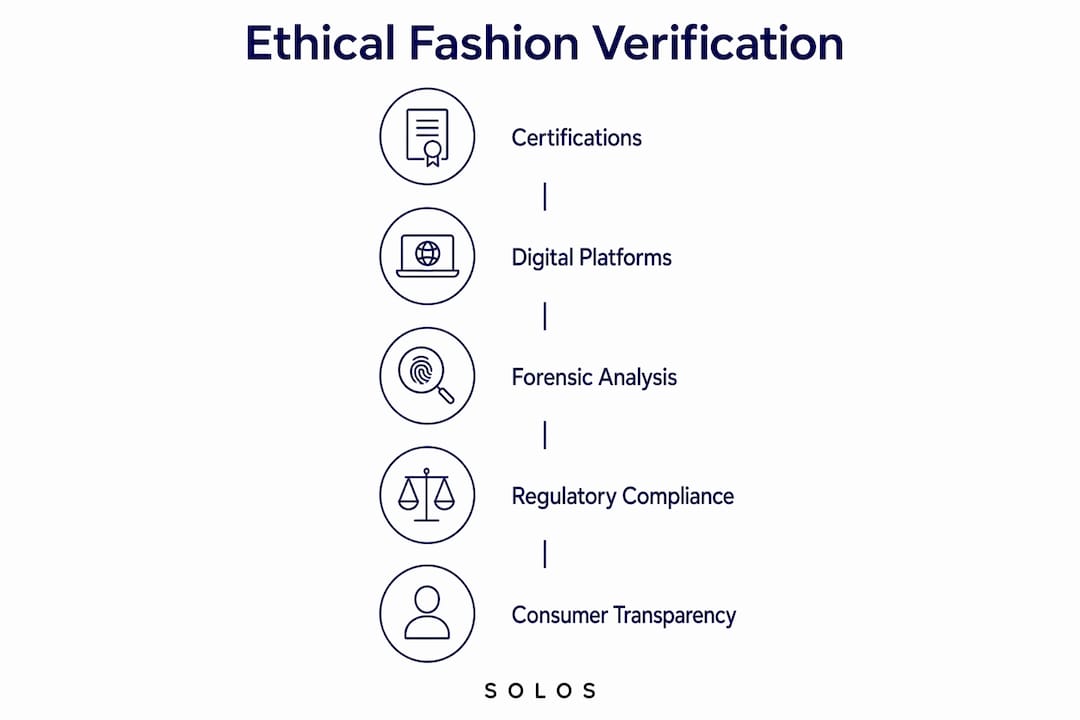
Independent verification registries are more reliable than brand marketing or manufacturer-provided certificates, especially when facilities are not publicly disclosed. If a brand cannot tell you who made your clothes, that silence is an answer in itself.
Key takeaways
Proving ethics in fashion requires a combination of independent certifications, forensic traceability, regulatory compliance, and transparent disclosure, not marketing claims alone.
| Point | Details |
|---|---|
| Audits are not proof | Commercial audits are often announced and brand-funded, making them unreliable as standalone evidence of ethical production. |
| Forensic testing raises the bar | Chemical marker testing physically verifies fibre origin and cannot be faked with paperwork. |
| 2026 regulations tighten claims | The EU ECGT bans vague green claims from 27 september 2026; the FTC Green Guides enforce similar standards in the US. |
| Registries beat marketing | GOTS and Fair Trade USA public registries let you verify certifications independently of brand claims. |
| Circularity has blind spots | Recycling facilities are often excluded from due diligence, creating unaddressed labour risks in circular fashion claims. |
The proof problem is real, and it is getting harder to hide
Working closely with sustainable fashion over the years, the pattern I keep seeing is this: the brands with the most polished sustainability messaging are often the ones with the least verifiable evidence behind it. A beautifully designed sustainability page with aspirational language and a few certification logos is not proof. It is a starting point for questions.
What genuinely impresses me is when a brand can show you the chain of custody. Not just “we use organic cotton” but “here is the farm, here is the test result, here is the certificate number you can look up.” That level of specificity is rare, and it is exactly what the new regulatory environment is pushing brands toward.
The part of the supply chain that worries me most is the part brands talk about least: the recycling facilities, the dye houses, the trim suppliers in countries with weak labour protections. These are the places where ethical failures happen and where due diligence is thinnest. A brand that only talks about its final assembly factory is showing you the tip of the iceberg.
My honest advice is to treat scepticism as a tool, not a barrier. Ask hard questions. Use the public registries. Look for the signs of a truly sustainable brand rather than accepting the surface story. The brands that are doing this properly will welcome your scrutiny. The ones that deflect it are telling you something important.
— Solos
Soloslife’s approach to verified ethical fashion
Soloslife builds its range of premium cotton essentials on the kind of transparency that holds up to scrutiny. Every piece in the Soloslife collection uses sustainably sourced cotton and non-toxic dyes, with sourcing and manufacturing practices designed to support responsible resource management and fair labour conditions.
If you want to see what verified ethical commitments look like in practice, the Soloslife sustainability page lays out the brand’s approach in specific, honest terms. No vague language, no unsubstantiated claims. For shoppers who want style and substance together, the Soloslife premium cotton range is a practical place to start. Ethical fashion does not have to mean compromise on quality or design.
FAQ
What does it mean for a fashion brand to prove ethics?
Proving ethics means providing verifiable evidence of fair labour, responsible sourcing, and environmental accountability through independent certifications, supply chain documentation, and third-party verification, not just marketing statements.
Are GOTS and Fair Trade USA certifications reliable?
Both certifications are independently verified and maintain public registries you can search directly. Cross-checking a brand’s claimed certification against the official registry confirms whether the claim is current and legitimate.
What is social washing in fashion?
Social washing is when a brand uses audit results or certification language to imply ethical production while real labour abuses remain unaddressed. The SOMO and Clean Clothes Campaign research identifies this as a structural problem in commercial audit systems.
How does forensic testing prove ethical cotton sourcing?
Forensic testing uses chemical markers and isotope analysis to match a fibre’s signature to a specific geographic origin. This physical verification cannot be replicated with forged documents, making it a stronger proof method than supplier declarations alone.
What do the 2026 EU green claims rules mean for shoppers?
From 27 september 2026, the EU ECGT directive prohibits vague environmental claims like “eco-friendly” or “sustainable” without specific substantiation. Shoppers in the EU can expect brands to either back their claims with evidence or stop making them.


