

TL;DR:
- Truly sustainable clothing brands are verified through certifications and transparent supply chain practices. Combining assessments of GOTS and OEKO-TEX certifications provides the most comprehensive evaluation. Consumers should scrutinize brand transparency reports and verified third-party data to avoid greenwashing and support genuinely ethical brands.
Truly sustainable clothing brands are defined by concrete, verifiable evidence of their environmental and ethical practices, not by marketing language alone. The industry term for this standard is supply chain due diligence, and it covers everything from organic fibre sourcing to fair labour conditions and chemical safety in finished garments. Certifications like the Global Organic Textile Standard (GOTS) and OEKO-TEX Standard 100 are the most credible indicators available to consumers today. To identify truly sustainable clothing brands with confidence, you need to know what each certification actually covers, how to read brand transparency reports, and what red flags signal greenwashing rather than genuine commitment.
What certifications actually tell you about sustainable brands
Certifications are the most reliable shortcut for evaluating eco-friendly apparel, but only when you understand what each one measures. Not all labels answer the same question, and confusing them leads to poor purchasing decisions.

GOTS: The Gold Standard for Organic Textiles
GOTS certifies the entire organic textile supply chain, from raw fibre through processing to the finished labelled product. It covers both environmental criteria, such as restricted chemical use, and social criteria, including fair wages and safe working conditions. A GOTS label on a garment means every stage of production has been independently audited. That is a significantly higher bar than most labels you will encounter.
OEKO-TEX Standard 100: Chemical Safety, Not Farming
OEKO-TEX Standard 100 certifies that a finished product is free from harmful levels of over 100 substances. What it does not certify is how the fibre was grown or whether workers were treated fairly. This distinction matters enormously. A garment can carry an OEKO-TEX label and still be made from conventionally grown cotton treated with synthetic pesticides.
Other Labels Worth Knowing
Fair Trade certification focuses on fair pricing and labour rights for farmers and workers. Bluesign addresses chemical safety and resource efficiency in textile manufacturing. The Soil Association’s organic certification covers farming practices and is particularly relevant for ethically sourced cotton, which avoids highly toxic substances and protects water quality through practices like crop rotation.
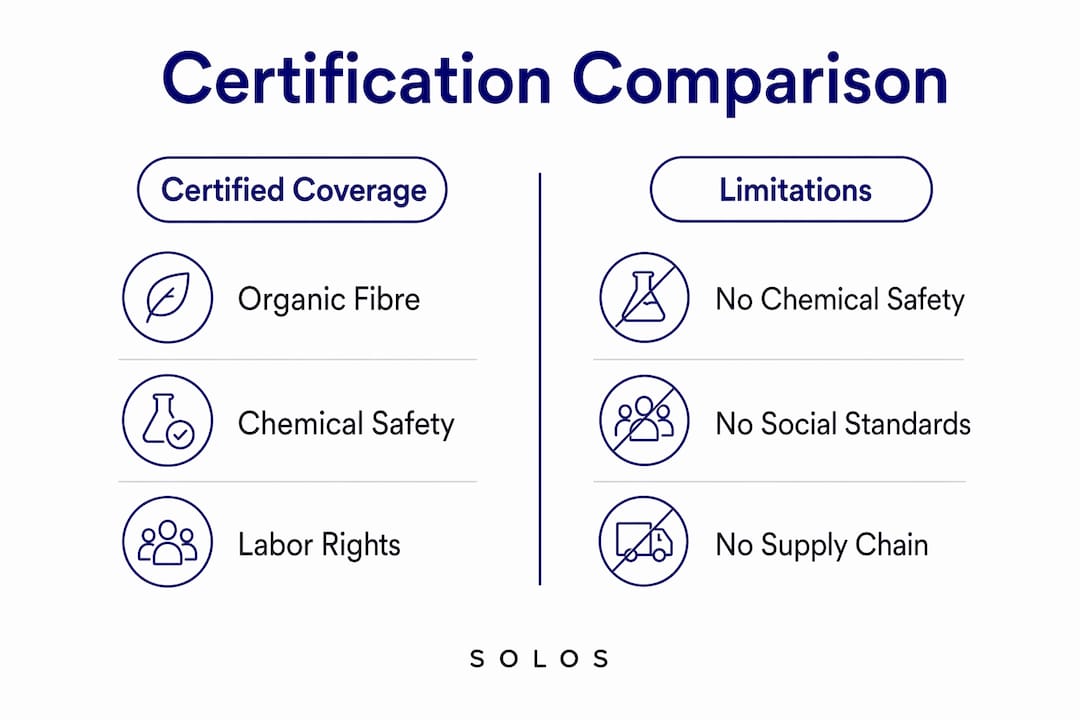
| Certification | What It Covers | What It Does Not Cover |
|---|---|---|
| GOTS | Organic fibre, processing, social standards | Finished product chemical residues (separately tested) |
| OEKO-TEX Standard 100 | Chemical safety in finished garment | Farming practices, labour conditions |
| Fair Trade | Fair wages, labour rights | Environmental farming or chemical safety |
| Soil Association Organic | Organic farming practices | Processing stages beyond fibre |
| Bluesign | Chemical safety in manufacturing | Farming, labour rights |
No single label tells the whole story. The best approach combines a supply chain certification like GOTS with a finished product check like OEKO-TEX for comprehensive coverage.
Pro Tip: When you see a certification logo on a brand’s website, search the certifying body’s public database to confirm the brand is actually listed. Logos can be used without current certification.
How do you assess brand transparency and due diligence?
Certifications confirm what a brand has achieved. Transparency reports reveal how a brand behaves when things go wrong, which is equally important for evaluating ethical clothing labels.
The OECD sets clear expectations for what credible supply chain disclosures should include. A brand demonstrating genuine sustainability maturity will publish the following:
- Named risks: Specific identification of environmental or social risks in their supply chain, not generic statements about “working toward improvement.”
- Mitigation actions: Concrete steps taken to address those risks, with timelines and responsible parties named.
- Outcome tracking: Measurable results showing whether mitigation worked, such as reduced water usage figures or audit outcomes.
- Grievance mechanisms: A clear process for workers or communities to raise concerns, with evidence it is actually used.
Brands that publish only aspirational copy, such as “we care about the planet,” without data or methodology, are not meeting these standards. The EU’s ECGT Directive, effective september 2026, bans generic and unsubstantiated environmental claims outright. This regulation compels brands selling into European markets to back every sustainability claim with auditable, third-party verified evidence.
Practical ways to verify brand transparency include reviewing annual sustainability reports, checking whether the brand publishes supplier lists, and looking for third-party audit summaries rather than self-reported data. Brands with genuine commitment to sustainable fashion best practices do not hide this information. They publish it prominently because it is a competitive advantage.
Pro Tip: Ask a brand directly: “Can you share your most recent third-party audit results?” A credible brand will answer with specifics. A brand deflecting with marketing language is telling you something important.
Practical steps to find sustainable clothing brands when shopping
Evaluating eco-conscious brands does not require a degree in textile science. A clear, repeatable process gets you reliable answers in minutes.
-
Check for named certifications first. Look for GOTS, OEKO-TEX, Fair Trade, or Soil Association logos on product pages. Then verify the brand appears in the certifying body’s public database.
-
Read the sustainability page critically. Look for specific numbers, not just claims. “We use 30% recycled polyester in our packaging” is credible. “We are committed to a greener future” is not.
-
Trace sourcing origins where possible. The best sustainable cotton clothing brands in 2026 name their cotton farms or at minimum their country of origin. Vague references to “responsibly sourced materials” without geography or supplier names are a warning sign.
-
Cross-reference with third-party resources. Certification databases from GOTS and OEKO-TEX are publicly searchable. Use them.
-
Assess durability as a sustainability factor. A garment made to last five years has a lower environmental footprint than a cheap alternative replaced annually. Understanding quality cotton construction is part of evaluating true sustainability.
-
Check for non-toxic dye disclosures. Conventional textile dyeing is one of the largest sources of industrial water pollution globally. Brands using sustainable dyeing processes will say so explicitly and often reference OEKO-TEX or Bluesign compliance.
| Common Claim | What to Look For Instead |
|---|---|
| “Eco-friendly” | Named certification or specific data point |
| “Sustainably sourced cotton” | GOTS certification or named farm/country of origin |
| “Non-toxic dyes” | OEKO-TEX Standard 100 or Bluesign verification |
| “Ethical production” | Fair Trade certification or published supplier audit |
| “Reducing our carbon footprint” | Specific percentage reduction with baseline year |
Europe is moving toward banning vague environmental claims by 2026, requiring concrete numbers and named third-party methodologies. This shift means the brands that survive regulatory scrutiny will be the ones worth buying from.
Pro Tip: Conventional cotton accounts for 16% of global insecticide use. When a brand claims organic cotton without GOTS or Soil Association certification, ask for the proof. The data gap between claim and reality is often significant.
What are the biggest mistakes when evaluating sustainable brands?
Even informed shoppers make predictable errors when assessing top ethically sourced cotton apparel. Knowing these pitfalls saves time and money.
Trusting a single label as the full picture
One certification answers one question. Combining certifications gives you a complete picture. A brand with GOTS certification but no OEKO-TEX verification may still have chemical safety concerns in its finished garments. Always ask what question each label actually answers.
Accepting aspirational language as evidence
Phrases like “we believe in sustainability” or “our mission is a better planet” are marketing, not proof. Credible brands name risks, show mitigation efficacy, and explain tracking methods. If a brand’s sustainability page reads like a values statement rather than a report, treat it with scepticism.
Overlooking the full supply chain
A brand may use organic cotton but process it in a facility with poor labour conditions or heavy chemical use. GOTS addresses this by covering the full chain. Brands that only certify their raw material without addressing processing are offering partial sustainability at best.
Red flags to watch for:
- No certifications listed, or certifications not verifiable in public databases
- Sustainability claims with no data, percentages, or methodology
- No supplier information or country of origin disclosed
- Sustainability page updated less than once per year
- No mention of grievance mechanisms or worker welfare programmes
Best practices to counter these pitfalls:
- Use the sustainable cotton fabric guide to understand what certified organic cotton actually means before shopping
- Cross-check brand claims against common sustainability myths to avoid being misled
- Prioritise brands that publish annual sustainability reports with measurable outcomes over those with polished but vague marketing
Key takeaways
Truly sustainable clothing brands are identified by combining verified certifications, transparent supply chain disclosures, and measurable environmental and social outcomes rather than marketing claims alone.
| Point | Details |
|---|---|
| Certifications answer specific questions | Match the certification type to the sustainability claim you are evaluating. |
| GOTS covers the full supply chain | GOTS is the most comprehensive label, covering fibre, processing, and social standards. |
| OEKO-TEX confirms chemical safety only | Use OEKO-TEX alongside GOTS for a complete picture of a garment’s sustainability. |
| Transparency reports reveal brand maturity | Look for named risks, mitigation actions, and measurable outcomes, not aspirational copy. |
| ECGT rules raise the bar from september 2026 | Brands unable to substantiate claims with data will face regulatory consequences in European markets. |
Why verification beats trust in sustainable fashion
My honest view is that the sustainable fashion conversation has been dominated by brand storytelling for too long. We have reached a point where the gap between what brands say and what they can prove is the single most useful signal available to consumers.
The ECGT Directive is the most significant shift I have seen in years. It moves the burden of proof from consumers to brands, which is exactly where it belongs. Before this regulation, a brand could print “eco-friendly” on a swing tag with no accountability. From september 2026, that approach carries legal risk in European markets. Australian brands selling internationally will feel this pressure too.
What I find genuinely encouraging is that the tools for verification have never been more accessible. GOTS and OEKO-TEX both maintain public databases. The OECD’s due diligence framework gives consumers a clear template for what good reporting looks like. You do not need to take a brand’s word for anything anymore.
The brands worth supporting are the ones that welcome scrutiny. They publish supplier lists, share audit results, and update their sustainability data annually. That behaviour is not just admirable. It is the minimum standard for what “sustainable” should mean in 2026.
— Solos
Soloslife makes verification easy
If you have spent time learning how to evaluate sustainable brands, Soloslife is worth a close look. The brand’s premium cotton essentials are built around certified organic cotton, non-toxic dyes, and transparent manufacturing practices that align directly with the criteria covered in this article.
Soloslife does not rely on vague claims. The brand’s sustainability commitments are published clearly, covering sourcing, dyeing processes, and fair labour practices. For eco-conscious shoppers who have done the research and want a brand that holds up to scrutiny, Soloslife’s range of t-shirts and polos offers a practical starting point for building a wardrobe you can feel confident about.
FAQ
What does ethically sourced cotton mean?
Ethically sourced cotton is grown and processed under conditions that protect worker rights, avoid harmful chemicals, and minimise environmental damage. Certifications like GOTS and Fair Trade are the most reliable indicators that cotton meets these standards.
How do i spot greenwashing in clothing brands?
Greenwashing is identified by vague claims without data, certifications that cannot be verified in public databases, and sustainability pages that read as values statements rather than reports with measurable outcomes. The EU’s ECGT Directive, effective september 2026, bans these unsubstantiated claims in European markets.
Is GOTS or oeko-tex more important for sustainable clothing?
Both serve different purposes. GOTS covers the full organic supply chain including social standards, while OEKO-TEX Standard 100 verifies chemical safety in the finished garment. Using both together gives the most complete picture of a garment’s sustainability credentials.
What should a brand’s sustainability page include?
A credible sustainability page names specific risks in the supply chain, describes mitigation actions taken, shares measurable outcomes, and identifies third-party verification. Brands following OECD due diligence guidance will include grievance mechanisms and outcome tracking data.
Does organic cotton make a meaningful environmental difference?
Organic cotton farming avoids highly toxic substances and protects water quality through practices like crop rotation. Conventional cotton accounts for 16% of global insecticide use, making the shift to certified organic cotton one of the most impactful choices available in sustainable apparel.


