

TL;DR:
- Eco-friendly fabric minimizes environmental impact throughout its entire lifecycle by using sustainable raw materials and low-pollution production methods. The most trusted options are natural fibers like organic cotton and hemp, and certified fabrics such as GOTS and Bluesign verify genuine eco claims. Durability and proper certification are key to ensuring these fabrics contribute to a truly sustainable wardrobe and ecosystem.
Eco-friendly fabric is defined as textile designed and manufactured to minimise environmental impact across its entire lifecycle, from raw material sourcing through to disposal. The term covers four core pillars: sustainable raw materials, low-pollution production, non-toxic processing, and biodegradable or recyclable end-of-life options. Certifications like GOTS (Global Organic Textile Standard), OEKO-TEX Standard 100, and Bluesign exist specifically to verify these claims, because the label “eco-friendly” carries no legal definition and is frequently misused. Understanding what the term actually means gives you the knowledge to shop with confidence and avoid greenwashing.
What does eco-friendly fabric mean, exactly?
The industry term you will encounter alongside “eco-friendly fabric” is sustainable textile. The two phrases overlap but are not identical. Eco-friendly focuses on reduced environmental harm — pesticide-free farming, lower water consumption, fewer synthetic chemicals — whereas sustainability also folds in ethical labour practices and full lifecycle impact. A fabric can be eco-friendly but fall short of being truly sustainable if the workers producing it are exploited or if excessive waste occurs during manufacturing.
This distinction matters when you are reading brand claims. A t-shirt made from organic cotton ticks the eco-friendly box. The same t-shirt made in a certified fair-trade facility using renewable energy ticks the sustainable box. Both are worth pursuing, but they are not the same thing, and knowing the difference helps you ask better questions before you buy.
What materials and fibres are used in eco-friendly fabrics?
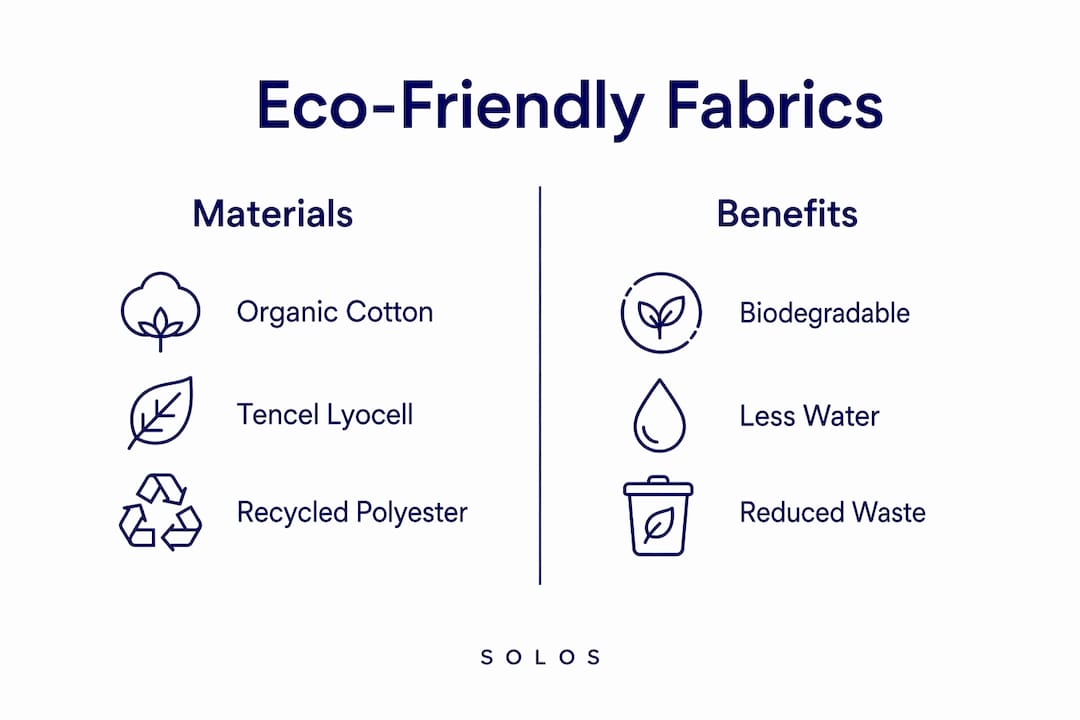
Three main categories dominate eco-friendly fabric types: plant-based natural fibres, lower-impact man-made fibres, and recycled materials. Each brings a different environmental profile to the table.
Plant-based natural fibres are the most widely recognised sustainable fabric options:
- Organic cotton is grown without synthetic pesticides or fertilisers, reducing soil and waterway contamination compared to conventional cotton farming.
- Hemp requires minimal water, no pesticides, and actually improves soil health through a process called phytoremediation.
- Linen (from flax) uses very little water and every part of the flax plant is usable, generating almost no waste.
- Bamboo grows rapidly without pesticides, though the chemical processing required to turn bamboo into soft fabric can offset some of its environmental gains if not managed carefully.
Lower-impact man-made fibres include Tencel lyocell, produced from sustainably sourced wood pulp in a closed-loop process that recaptures and reuses over 99% of the solvent used. This makes it one of the cleaner options in the man-made fibre category.
Recycled materials such as recycled polyester (made from PET plastic bottles) and recycled cotton divert waste from landfill. They carry a lower production footprint than virgin synthetics, though recycled polyester still sheds microplastics during washing.
| Fibre | Key environmental benefit | Limitation |
|---|---|---|
| Organic cotton | No synthetic pesticides | Still water-intensive |
| Hemp | Improves soil, minimal water | Limited mainstream availability |
| Linen | Near-zero waste production | Can wrinkle easily |
| Tencel lyocell | Closed-loop solvent process | Requires certified sourcing |
| Recycled polyester | Diverts plastic waste | Microplastic shedding |
Natural fibres like cotton, linen, hemp, and bamboo are biodegradable and do not shed microplastics, unlike polyester which can take up to 200 years to decompose. That end-of-life difference alone is a compelling reason to favour natural fibres where possible. For a deeper look at how cotton compares to synthetics in everyday wear, the guide on cotton vs synthetics is worth reading.
How is eco-friendly fabric made differently from conventional textiles?
The production process is where eco-friendly textiles diverge most sharply from conventional manufacturing. Sustainable textiles use recycled or organic raw materials, low-water dyeing, and certified manufacturing processes that limit chemical runoff and energy consumption. Conventional textile dyeing is one of the world’s largest sources of industrial water pollution, so the shift to low-impact alternatives is significant.
Here is how eco-friendly production differs at each stage:
- Raw material cultivation uses organic farming methods or sustainably managed forests, eliminating synthetic pesticides and reducing water draw.
- Dyeing and finishing relies on low-water or waterless dyeing technologies, plant-based dyes, or OEKO-TEX certified dye systems that exclude harmful substances like azo dyes and formaldehyde.
- Chemical processing avoids chlorine bleaching and heavy metal-based treatments, replacing them with hydrogen peroxide or enzyme-based alternatives.
- Energy use in certified mills is increasingly sourced from renewables, with Bluesign-certified facilities required to meet strict resource productivity benchmarks.
- Wastewater treatment in compliant factories captures and treats effluent before discharge, preventing toxic runoff into local waterways.
Modal fabric manufacturing uses roughly 10 to 20 times less water than conventional cotton production. That scale of saving, replicated across millions of garments, represents a meaningful reduction in pressure on freshwater systems globally.
Pro Tip: When assessing a brand’s production claims, look for Bluesign certification specifically. It audits the entire supply chain for resource efficiency, not just the finished product, making it one of the most rigorous production-level standards available.
Ethical labour is part of this picture too. Eco-friendly production practices mean little if the people making the garments are underpaid or working in unsafe conditions. GOTS certification, for instance, includes social criteria alongside its environmental requirements, which is why it remains the gold standard for organic textiles.
What certifications verify eco-friendly fabric claims?
Certifications are the most reliable tool you have for cutting through vague marketing language. Genuine eco-friendly fabrics should be backed by third-party certifications like GOTS, Bluesign, or OEKO-TEX Standard 100. Each covers a different scope, so understanding what each one actually audits is useful.
- GOTS (Global Organic Textile Standard) covers the entire supply chain from fibre to finished garment, including environmental and social criteria. It requires a minimum of 70% certified organic fibres and prohibits a long list of harmful chemicals.
- OEKO-TEX Standard 100 tests every component of a finished product, including threads, buttons, and zips, for harmful substances. It does not certify organic farming or labour practices, but it does confirm the garment is free from toxic residues.
- Bluesign focuses on manufacturing facilities, auditing for responsible use of resources, chemical safety, and worker health. It is the standard most relevant to production-stage environmental claims.
For professional verification, request the certificate number and confirm its scope through the certifier’s own database. A logo printed on a hangtag or website is not sufficient evidence of active certification. GOTS maintains a public database at global-standard.org where you can search by company name or certificate number. OEKO-TEX offers the same through its OEKO-TEX Label Check tool.
Pro Tip: Search the certifier’s database before purchasing, not after. An active, product-scoped certificate confirms the specific item you are buying meets the standard, not just the brand in general.
Common misleading claims to watch for include “natural,” “green,” “eco,” and “plant-based” used without certification backing. These terms are unregulated and tell you nothing verifiable about how the fabric was produced or what chemicals it contains. For more on identifying genuinely sustainable fashion practices, it is worth understanding the broader framework these certifications sit within.
How do eco-friendly fabrics benefit consumers and the environment?
The benefits of eco-friendly fabrics operate on two levels: what they do for you as the wearer, and what they do for the planet over time.
For the wearer, natural fibres deliver real performance advantages. Linen is up to three times stronger than cotton, which means linen garments last significantly longer and require less frequent replacement. That durability directly reduces the volume of clothing sent to landfill. Hemp shares similar strength characteristics, and both fibres become softer with each wash rather than degrading. Organic cotton and linen are also naturally hypoallergenic, making them a practical choice for people with sensitive skin or chemical sensitivities.
For the environment, the gains are measurable across several dimensions:
- Water savings from switching to lower-impact fibres and dyeing processes reduce pressure on freshwater systems in textile-producing regions.
- Pesticide elimination in organic farming protects soil biodiversity and prevents chemical runoff into rivers and groundwater.
- Microplastic reduction comes from choosing natural fibres over synthetics, since natural fibres do not shed microplastics during washing the way polyester and nylon do.
- Biodegradable disposal means natural fibre garments break down at end of life rather than persisting in landfill for decades.
The most sustainable fabric is one that lasts. Durability reduces demand for new resources and minimises the carbon footprint of your wardrobe over time. Buying one well-made linen shirt that lasts eight years is a better environmental outcome than buying four cheaper shirts that each last two. The guide on why quality reduces waste explores this logic in practical detail.
Key takeaways
Eco-friendly fabric is defined by sustainable raw materials, certified low-impact production, and biodegradable disposal, and durability is the factor that determines whether those qualities translate into real environmental benefit over time.
| Point | Details |
|---|---|
| Core definition | Eco-friendly fabric minimises environmental impact across its full lifecycle, from farming to disposal. |
| Top fibre choices | Organic cotton, hemp, linen, and Tencel lyocell offer the strongest environmental profiles among available options. |
| Certification matters | GOTS, OEKO-TEX Standard 100, and Bluesign are the three certifications worth verifying before purchasing. |
| Durability is the multiplier | Longer-lasting garments reduce replacement frequency and lower your wardrobe’s overall resource footprint. |
| Blended fabrics carry risk | Poly-cotton blends are difficult or impossible to recycle, limiting their circular economy potential. |
Our honest view on eco-friendly fabrics
We have spent a lot of time working with sustainable cotton, and the thing that surprises most people is how much the “eco-friendly” label can obscure rather than clarify. A fabric can tick every environmental box during production and still end up in landfill after 18 months because it was made cheaply. That is not a sustainable outcome by any reasonable measure.
The fabrics we trust most are the ones that hold up. Organic cotton that is tightly woven and properly finished outlasts loosely constructed alternatives, even if both carry the same certification. Blended fabrics with natural fibres mixed with synthetic polymers create real problems at end of life because they cannot be cleanly recycled. We avoid them for that reason, even when the blend improves short-term softness or stretch.
Our caution about greenwashing is not cynicism. It is a practical response to a market where unverified claims are common. The brands doing this properly, those with active GOTS or Bluesign certificates and transparent supply chains, are not hard to find once you know what to look for. The recycled fabric clothing space is also worth understanding, particularly for accessories and outerwear where natural fibres are less practical.
The simplest advice we can offer: buy less, buy certified, and buy things built to last. That combination does more for your environmental footprint than any single fabric choice in isolation.
— Solos
Explore Soloslife’s sustainable cotton essentials
At Soloslife, every piece in our collection is built around certified eco-friendly cotton, non-toxic dyes, and responsible manufacturing. Our men’s cotton t-shirts and polos are made to wear well and last long, which is the most honest form of sustainability we know. We are not interested in vague green claims. We back our materials with verified certifications and transparent sourcing practices you can read about on our sustainability page. If you are building a wardrobe that reflects your values without compromising on quality or style, that is exactly what we are here for.
FAQ
What is the definition of eco-friendly fabric?
Eco-friendly fabric is textile designed to minimise environmental harm across its lifecycle, covering sustainable raw materials, low-pollution production, non-toxic processing, and biodegradable or recyclable disposal.
What are the most common eco-friendly fabric types?
The most widely used types are organic cotton, hemp, linen, Tencel lyocell, and recycled polyester, each offering a different balance of environmental benefit and wearability.
How can I tell if a fabric is genuinely eco-friendly?
Look for third-party certifications like GOTS, OEKO-TEX Standard 100, or Bluesign, and verify the certificate number directly through the certifier’s public database rather than relying on a logo alone.
Are blended fabrics eco-friendly?
Blended fabrics that combine natural fibres with synthetic polymers, such as poly-cotton, are difficult or impossible to recycle and limit circular economy potential, making them a weaker choice for end-of-life sustainability.
Why does fabric durability matter for sustainability?
A durable garment reduces how often you need to replace it, which lowers demand for new resources and decreases the overall carbon footprint of your wardrobe over time.


